ROOFING GROWTH RESOURCE
Missed Call Text Back: Quick Setup and Templates
Set up missed call text back to engage leads instantly with automated replies. Learn quick steps and templates for success today!
Missed Call Text Back: Quick Setup and Templates
Missed call text back is an automated SMS that fires the moment a call goes unanswered, giving the caller an instant reply instead of dead silence. A large majority of callers who hit voicemail never leave a message, so a text is often the only shot you get at that lead.
Do this in the next hour:
Pick or confirm the business number you’ll route missed calls through.
Turn on the missed-call trigger and set a 1 to 5 second delay before the text sends.
Paste in a short template that names your business and gives one next step.
Pro Tip: Test this on your own phone first. Call your business line, let it ring out, and time how fast the text lands. If it takes longer than five seconds, the caller has usually already moved on to your competitor’s number.
Key Takeaways
Missed call text back works because it replaces silence with an instant, low-friction reply, and pairing that speed with clear next steps and measurement is what turns recovered calls into booked revenue.
Point | Details |
|---|---|
Speed decides outcomes | Send the text within 1 to 5 seconds of the missed call while the caller still has their phone out. |
Dedupe prevents spam complaints | Set a 5 to 15 minute window so repeat callers get one text, not three. |
Templates need one next step | Every message should name your business and offer a single clear action, not multiple options. |
Compliance protects deliverability | Register for 10DLC where required, use a consistent sender ID, and always include an opt-out line. |
Sapentis handles the full loop | Sapentis connects missed calls, web leads, and calendars so roofing contractors recover bookings automatically. |
Table of Contents
How Does Missed Call Text Back Actually Work?
Who Benefits Most From an Automated Text Response to a Missed Call?
How Do You Set Up a Missed Call Text Back System?
What Should a Missed Call Text Actually Say?
Is Missed Call Text Back Compliant and Deliverable?
What Metrics Prove Missed Call Text Back Is Working?
What Mistakes Kill Missed Call Text Back Performance?
How One Roofing Automation Deployment Moved the Needle
Get Missed Calls Working for You, Not Against You
Sources
How Does Missed Call Text Back Actually Work?
The flow is simple: a call rings out or hits voicemail, that event triggers an SMS, and the text either answers a question or routes the caller to a booking link. Three settings control how well it performs.
Ring timeout decides how many rings count as “missed.” Most businesses set it at a few rings.
Voicemail vs. ring-out logic determines whether the text fires only after voicemail or immediately when the call disconnects unanswered.
Business-hours rules swap in a different message after close, since “we’ll call you back in 10 minutes” is a broken promise at 9 p.m.
Dedupe logic matters more than most owners expect. If the same number calls three times in five minutes because they’re anxious to reach you, platforms typically hold a short window so you send one text, not three. Sending speed matters just as much. Research on response timing points to 1 to 5 seconds as the window where reply rates peak, because the caller’s phone is still in their hand.
Who Benefits Most From an Automated Text Response to a Missed Call?
Any business that loses revenue when the phone goes unanswered benefits, but some categories feel it harder than others. Roofers, HVAC techs, and plumbers are usually mid-job when the phone rings, so missed calls happen constantly and callers rarely wait around. Dental and medical offices deal with high call volume during business hours, and salons and medspas lose same-day bookings to whoever answers first.
Faster acknowledgment cuts the awkward silence that pushes callers to call your competitor next.
SMS gets read fast. Open rates and reply behavior consistently beat email and voicemail callbacks.
Less phone tag means fewer wasted calls back and forth trying to connect.
The ROI math is compelling. If one roofing estimate averages significant signed work, recovering a single missed lead per month typically covers the entire cost of a text-back platform, with everything after that as margin.
How Do You Set Up a Missed Call Text Back System?
Setup breaks into five stages. Skip any one of them and the system either misfires or annoys callers instead of converting them.
Choose your number and platform. If you already run VoIP or a CRM with calling features, check whether it supports missed-call triggers natively before adding a separate tool. Twilio-based platforms and most modern phone systems support this out of the box.
Configure the trigger. Set your ring timeout, decide whether the text fires on ring-out or after voicemail, and build separate rules for business hours versus after-hours. Set your dedupe window (5 to 15 minutes is typical) so repeat callers only get one message.
Write your live templates. Draft the actual text with merge fields for business name and caller name where available, add your booking link, and include opt-out language.
Test before you trust it. Call your own line and let it ring out during business hours, then repeat after hours. Confirm the sender ID looks right, the booking link opens correctly, and the dedupe logic doesn’t send duplicates when you call twice.
Assign an owner. Decide who watches for replies, how fast they need to respond, and when a text conversation should escalate to a phone call. Without an owner, texts pile up unanswered and you’ve just moved the missed-call problem into a missed-text problem.
Pro Tip: Run your test during a slow hour, not right before a big rush. You want time to catch a broken link or a typo before real leads see it.
What Should a Missed Call Text Actually Say?
Good missed-call texts share a structure: name your business, acknowledge the miss, and give one clear next step. Keeping the message short and human outperforms anything that reads like a corporate auto-reply.
General template: “Hi, this is [Business Name] — sorry we missed your call! Reply here or call back and we’ll get you taken care of.”
Booking-focused: “Thanks for calling [Business Name]! Grab a time that works for you here: [booking link].”
Service/estimate request: “Hi [Caller Name], we missed you but we’re on it. Want a free roof estimate? Just reply YES and we’ll set a time.”
After-hours: “Thanks for calling [Business Name]. We’re closed until [time], but you can book a slot now: [booking link].”
Internal follow-up (to your team): “Missed call from [Caller Name] at [time] — text sent, no reply yet. Follow up by [time].”
Keep every message under 160 characters where you can, give one next step instead of three options, and skip anything that sounds like a sales pitch.
Is Missed Call Text Back Compliant and Deliverable?
Yes, when you follow a few basic rules. Every text should name your business, state a clear purpose, and include an opt-out instruction like “reply STOP to unsubscribe.” Do not send marketing messages after the initial reply unless the caller has opted in separately.
Register your number under 10DLC requirements if your carrier or platform requires it. Unregistered numbers get filtered or blocked far more often.
Use one consistent sender ID so repeat callers recognize your texts instead of flagging them as spam.
Watch for carrier filtering issues and avoid link-heavy or all-caps messages that trip spam filters.
Filter out one-ring hang-ups and set dedupe windows so accidental dials don’t trigger unnecessary texts.
What Metrics Prove Missed Call Text Back Is Working?
Track five numbers: missed-call volume, reply rate, booking rate from text, time-to-response, and recovered revenue per booking. Measuring outcomes rather than just activity is what separates a system that looks busy from one that actually pays for itself.
Tag SMS-originated bookings in your CRM so you can trace revenue back to the text, not just the call.
Use call-tracking numbers if you run multiple campaigns, so you know which source triggered the missed call.
Run a simple formula: (bookings recovered × average job value × conversion lift) minus your monthly platform and messaging cost.
What Mistakes Kill Missed Call Text Back Performance?
The biggest failure points are avoidable. Duplicate texts from poor dedupe logic annoy callers fast, fix it by tightening your dedupe window. Generic messages with no next step get ignored, add a booking link or a direct question instead. No follow-up owner means replies sit unanswered for hours, assign someone and set a response SLA. Audit your setup monthly: check dedupe timing, sender reputation, and whether after-hours messages are actually firing.

How One Roofing Automation Deployment Moved the Needle
Roofing contractors lose estimates constantly because crews can’t answer the phone mid-job. Sapentis connects missed calls, web form leads, and calendar availability into one flow, so a caller who gets no answer receives an instant text with a link straight to an open estimate slot.
Instant response to a missed call or web lead, paired with automatic booking to the calendar, is the single biggest lever a roofing company has for recovering leads it would otherwise never see again.
The integration matters as much as the speed. Sapentis pulls from calls, forms, and paid ad leads into one qualification flow, so sales teams only see leads worth calling.
Why speed and personalization beat everything else
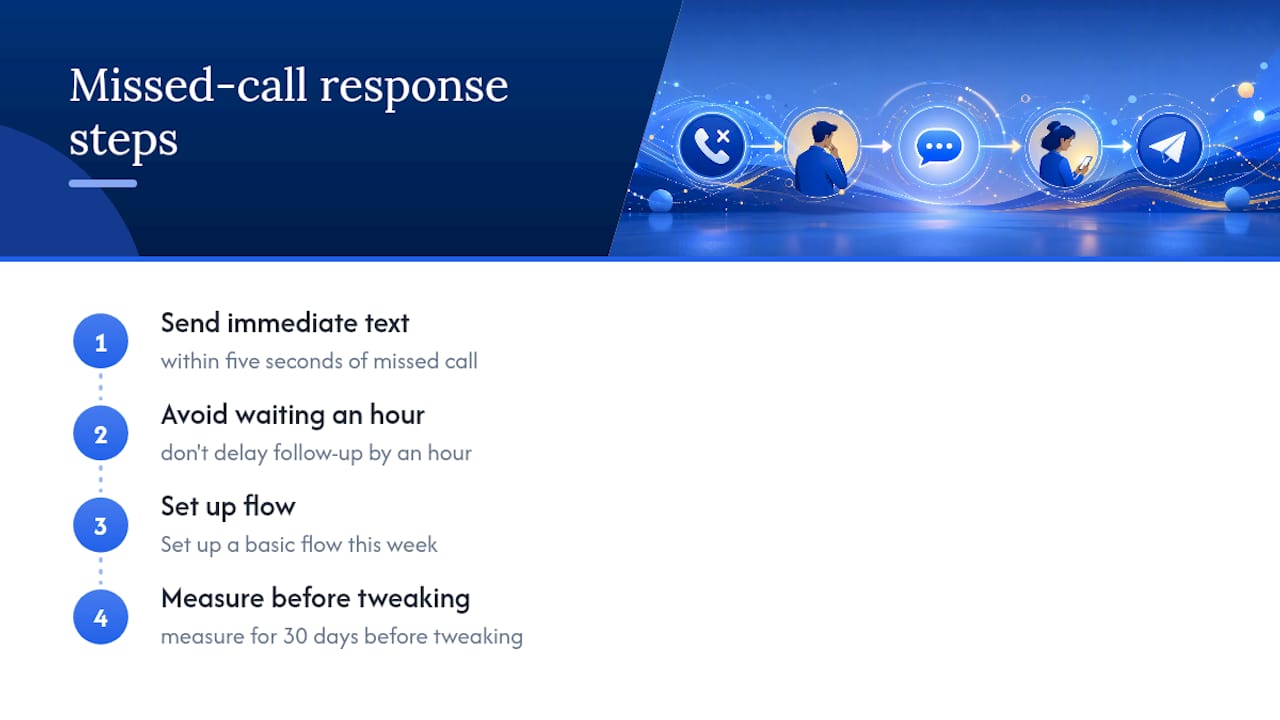
Speed wins deals. A caller who gets a text in five seconds is still holding their phone, still thinking about their roof, still ready to book. Wait an hour and that same caller has already called two competitors. Set up a basic flow this week and measure it for 30 days before you tweak anything.
Get Missed Calls Working for You, Not Against You
Sapentis is built specifically for residential roofing companies that lose estimates to slow response times, not a generic texting tool retrofitted for your industry. Where most missed-call setups stop at “send a text,” Sapentis connects that text to instant lead qualification and direct calendar booking, so a missed call turns into a scheduled estimate without a sales rep lifting a finger.

If you’re losing even one estimate a month to a call that went unanswered, that’s likely enough lost revenue to cover a subscription outright. Start with a free audit of your current lead response setup and see exactly how many calls and web leads are slipping through before you commit to anything.